Dial down the FREE Subscription for such premium content on our YouTube channel.

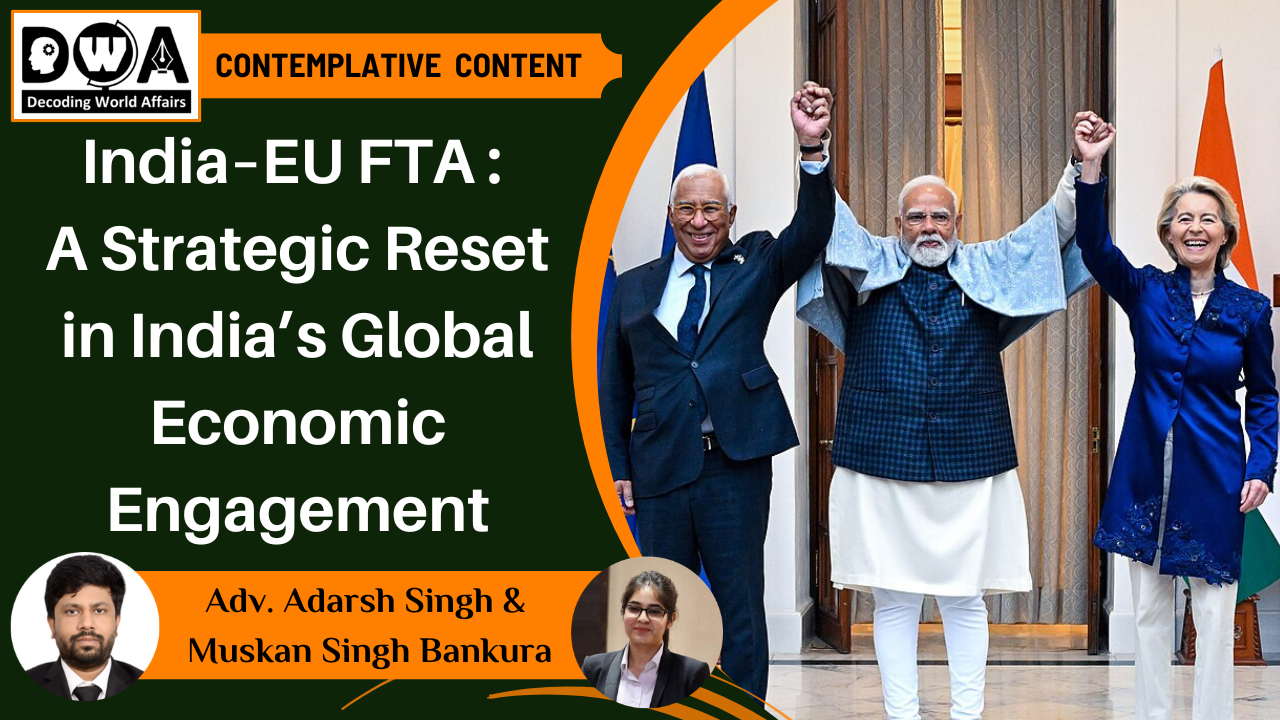
In an increasingly fragmented global economy, where supply chains are being redrawn and trade is shaped as much by geopolitics as by comparative advantage, the recently concluded Free Trade Agreement (FTA) between India and the European Union marks a decisive shift in India’s external economic strategy. More than a conventional tariff-reduction pact, the India–EU FTA represents India’s transition from a cautious, protection-oriented trade posture to a confident, rules-based engagement with one of the world’s largest and most sophisticated economic blocs.
India–EU Economic Relations in Perspective
India and the European Union share a long-standing economic partnership. The EU has consistently remained among India’s top trading partners, accounting for a significant share of merchandise trade, foreign direct investment, and technology inflows. However, negotiations for a comprehensive trade agreement remained stalled for years due to disagreements over market access, regulatory standards, investment protection, and labour and environmental concerns.

The revival and eventual conclusion of the agreement reflects a changed global and domestic context. India today is a more competitive economy, with stronger manufacturing capacity, a globally integrated services sector, and improved ease of doing business. Simultaneously, Europe is seeking reliable, democratic partners to diversify supply chains and reduce excessive dependence on a single geography.
Why the Agreement Matters?
The strategic importance of the India–EU FTA lies in three interlinked dimensions. First, it enables economic diversification. By deepening access to the EU’s vast consumer market, India reduces its reliance on a narrow set of export destinations and strengthens resilience against global shocks.
Second, it enhances supply-chain integration. European firms looking to de-risk production find in India a scalable manufacturing base, while Indian producers gain access to advanced technology, capital, and design capabilities. Third, it reinforces strategic autonomy. In a world of competing economic blocs, India positions itself as an independent yet indispensable partner, engaging with major powers without alignment dependence.
Key Features of the Agreement
The agreement is comprehensive in scope and forward-looking in design. Trade in goods forms its backbone, with phased elimination or reduction of tariffs on a majority of traded products. Indian exports such as textiles, garments, leather goods, pharmaceuticals, engineering products, and chemicals gain improved price competitiveness in European markets. In return, India opens up selectively to high-end industrial goods, machinery, and green technologies, with safeguard mechanisms for sensitive sectors.
Trade in services is a major gain for India. Enhanced market access for IT and IT- enabled services, professional services, and financial services strengthens India’s most competitive export segment. Provisions facilitating temporary movement of professionals and mutual recognition of qualifications, though gradual, create long-term opportunities for skilled Indian workers.
Investment protection and regulatory cooperation provide predictability and legal certainty, encouraging long-term European investments rather than short- term capital flows. This aligns with India’s objective of attracting stable, technology-intensive foreign investment.
Digital trade and intellectual property provisions address the realities of a modern economy, balancing innovation incentives with India’s developmental priorities. The framework supports cross-border data flows while preserving regulatory space.
Sustainability and labour commitments, often viewed as contentious, reflect the future direction of global trade. Rather than punitive conditio2nalities, the agreement emphasizes cooperation, capacity building, and gradual alignment with global norms.
Impact on Trade, GDP, and Employment of FTA
From an economic standpoint, the agreement is expected to deliver measurable medium- to long-term gains. Bilateral trade volumes are projected to rise substantially as tariff and non-tariff barriers fall. India’s export basket is likely to shift toward higher value-added goods and services, improving terms of trade. GDP gains, while incremental rather than dramatic, are structurally significant. Productivity improvements, technology transfer, and economies of scale contribute to sustained growth over time.
Employment generation is a critical outcome. Labour-intensive sectors such as textiles, apparel, leather, and logistics stand to benefit directly, while services- led growth supports high-skill job creation. Importantly, the agreement encourages formalisation and integration of MSMEs into global value chains. It bears emphasis that free trade agreements do not create growth automatically. They reward competitiveness. This agreement provides the framework; domestic capability determines results.
Geopolitical and Global Implications
Beyond economics, the India–EU FTA has clear geopolitical resonance. For Europe, India emerges as a central pillar of its Indo-Pacific economic strategy. For India, the agreement strengthens its position as a credible alternative manufacturing and services hub in a multipolar world.
The deal also sends a strong signal to other partners. It reinforces India’s commitment to rules-based trade and enhances its negotiating leverage in ongoing and future trade engagements with advanced and emerging economies alike. In today’s environment, trade agreements function as instruments of strategic alignment as much as commercial exchange. On that count, the agreement is a net positive.
Challenges and Criticisms
No trade agreement is without costs. Short-term adjustment pressures on small manufacturers, compliance burdens arising from regulatory standards, and concerns over environmental conditionalities are real and deserve attention.
However, these challenges are mitigated through phased implementation, safeguard clauses, and domestic policy support. The greater risk lies not in opening up, but in failing to adapt to a changing global trade architecture.
The Road Ahead
The true test of the India–EU FTA lies in implementation. Complementary domestic reforms—logistics efficiency, skill development, MSME support, and regulatory clarity—will determine the scale of benefits realised. Trade policy cannot substitute for structural reform; it can only amplify its outcomes.
The India–European Union Free Trade Agreement represents a strategic recalibration of India’s global economic engagement. It signals confidence in domestic capacity, commitment to high-quality growth, and readiness to shape
—rather than merely respond to—global trade rules.
Viewed through a long-term lens, the agreement is less about immediate export gains and more about embedding India into high-value global networks. In that sense, it is not just a trade deal; it is a statement of intent about India’s place in the world economy.
Support us
Hard work should be paid. It is free for all. Those who could not pay for the content can avail quality services free of cost. But those who have the ability to pay for the quality content he/she is receiving should pay as per his/her convenience. Team DWA will be highly thankful for your support.